
Undergraduate Research
Honors in Action®
PTK chapters conduct undergraduate research through the Honors in Action (HIA) program. HIA combines Honors Study Topic exploration, problem solving, and action-oriented service to address real-world challenges in our communities. Students gain job-related experience while creating lasting impacts in their communities as they engage in HIA.
Set yourself apart as a leader on campus.
Learn to think critically and reflectively.
Learn to work as part of a team.
Collaborate with college and community leaders.
The Honors in Action® program is designed to be accessible, flexible, and scalable, making it suitable for all chapters, regardless of factors such as student majors, chapter size, or college size. This adaptability allows every chapter to engage in meaningful scholarly research and service projects that align with their unique circumstances. For some institutions, Phi Theta Kappa’s Honors in Action® program even serves as the college’s official honors program, providing a structured, high-impact experience that enhances both the academic and leadership development of participating students.
How Honors in Action® Works
First, you’ll connect with your local chapter and other students like you to identify and research a theme from the current Honors Study Topic and an issue on your campus or in your larger community. Then, you’ll turn that research into a plan of action that meets a specific need in your area. You’ll expand your worldview and be able to give back through service — a win-win.
Through these experiences, students build practical and academic skills. By working closely with both their peers as well as campus and community leaders, students will learn not only how to research an issue but also how to utilize resources and build professional relationships.
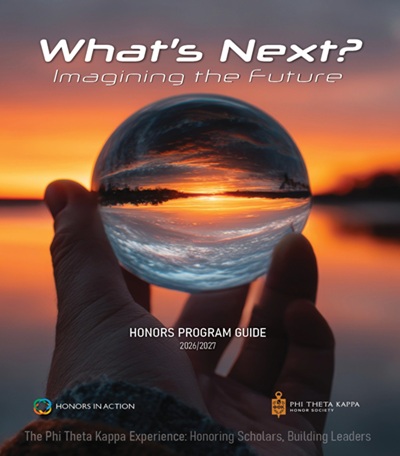
What's Next? Imagining the Future
What's Next? Imagining the Future is available to members and advisors behind their login. What's Next? Imagining the Future focuses on 8 themes:
Theme 1: What influence will relationships and identity have on how people interact with an ever-changing world in the future?
Theme 2: How will people recognize the appropriate need, time, and manner for separation and reconciliation?
Theme 3: How will people navigate the tensions between conviction and culture?
Theme 4: How will future societies balance individual liberties and social responsibilities?
Theme 5: How will migration and exchange influence the future of communities?
Theme 6: In what ways will data in all forms influence decision-making for the future?
Theme 7: Where and how will humans live, work, and play in the future?
Theme 8: How can humans design a better future, and what barriers stand in the way?
In This Section