By Guest Contributor Marlon P. Crespo
Marlon is a Phi Theta Kappa member at Hudson County Community College and the valedictorian of his graduating class.
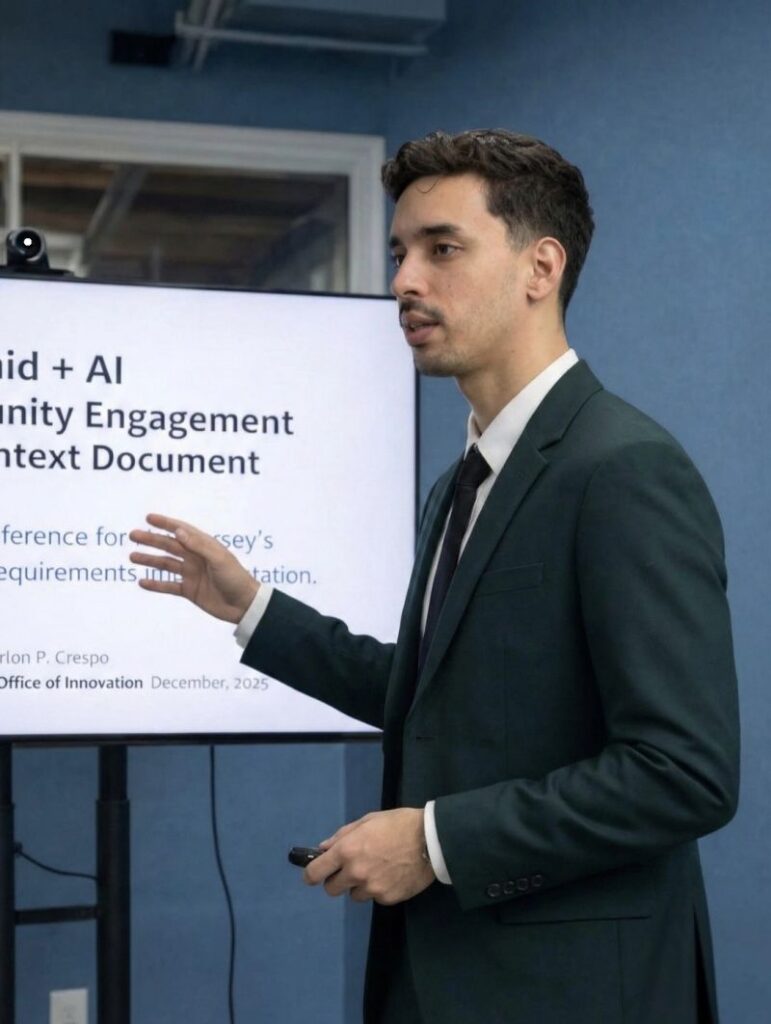
There’s a lot of noise right now about how AI will “fix everything”. This past fall, I worked as an AI Product Management Intern with the New Jersey Department of State in the Office of Innovation through an AI-focused program. That experience taught me something simple but important: the real work ahead for AI isn’t magic, it’s nuance, governance, and a deep understanding of human needs.
My path to this role was not a planned straight line; in fact it started with a complete reset. When I arrived in the U.S. from Cuba in 2023, I walked into a whole new world. I had to learn from scratch how to navigate a new language, new systems, new culture with no support net. During those early days, I was lucky to find help and guidance in a social organization called Church World Services (CWS). They provided me with food and legal assistance to primarily survive. But they did more than that. They opened the door to access education and with that to many opportunities I felt far away at that point in my life. That is how I ended up in Hudson County Community College (HCCC), my neighborhood educational center. It was nearby and it welcomed me with open arms without institutional burdens that otherwise would private me away from getting higher education in this country.
Breaking the barrier to school wasn’t easy. It took navigating financial aid, getting counseling to schedule classes while working and government support just to step into a class. But once I was in, I committed fully. After a successful first semester, I was invited to join the Phi Theta Kappa Honor Society (PTK) and that membership turned out to be pivotal for me.
The very first email I received from Theodore Lai, the PTK representative at HCCC, was about this government internship. An internship specifically for community college students to utilize their technical knowledge for the greater social good. The requirements were for sophomore students, and I was not quite there yet; but instead of letting the opportunity slip away, I challenged myself to complete all the necessary credits through summer school. I did not want to let a technicality stop me from even having the chance to be considered for this opportunity.
I was nervous during my first interview, fearing that I had no experience with this kind of meeting, but I soon realized that my lack of experience was not a disadvantage; it was, in fact, my strongest attribute. My outlook, motivations, and mission were all perfectly aligned with theirs. As a personal project, I showed them a chatbot and a mapping tool I had worked on to show the location of social services such as shelters, legal aid, food banks, and mental health clinics in Hudson County. I did not do this as a homework assignment, I did this because I needed this once. I built this inspired by the HudsonHelps program for students at HCCC.
I was selected as one of five fellows for this AI co-op program, developed in partnership with NJ Community Colleges, NJEDA, The Burnes Center for Social Change, and the New Jersey Department of State Office of Innovation, with collaboration across fellow cohorts in Massachusetts and Boston. During my time there, I had the opportunity to work within cross-functional teams spanning product, design, engineering, research, and policy. In the public sector, that mix isn’t optional, it’s how progress actually happens to create the most impact in people’s lives.
I supported high-profile initiatives like the NJ Government Feedback Widget, the testing phases of the NJ AI Assistant and the automatization for the check points in the Medicaid Program. My mentor, Ben Turndorf, went above and beyond to teach me that Product Management is less about shipping features and more about framing the problem correctly.
My biggest lesson? Technology is the easy part. The challenge lies in translation. In the public sector, you can build the most advanced algorithm, but if it doesn’t serve the people effectively, it fails.
I am incredibly grateful for the first access to education provided by Hudson County Community College, to Phi Theta Kappa for bridging the gap to this opportunity, and for the trust given to me by the New Jersey Office of Innovation to have a hand in something great.
This experience has completely changed the trajectory of my career aspirations. I am no longer just a Computer Science major; I am someone who cares about civic tech and the responsible use of AI to have a greater effect on society.